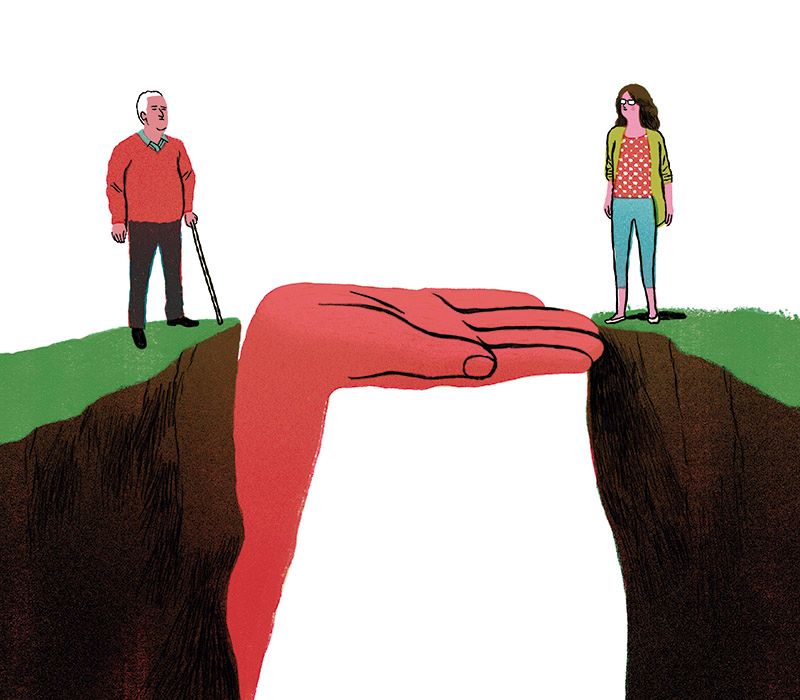

There is a strange thing that can happen when you begin therapy: you start changing, but the people around you don't necessarily change with you. At first, this can feel hopeful. You begin to understand yourself in ways you never have before. You recognize patterns that once felt like personality flaws. You learn that the way you respond to conflict may have more to do with what you learned about relationships than with what is actually happening in the present moment. You become more aware of your boundaries, your needs, your nervous system, and the ways you have learned to make yourself smaller, quieter, easier, or more accommodating in order to maintain connection.
And then you interact with your family and are bluntly reminded that everyone else is still playing the same game you are trying desperately to unlearn.
When You Are the One Doing the Work
This can be one of the most painful parts of therapy. You have spent months or years doing something incredibly vulnerable: looking honestly at yourself, examining your childhood, questioning your assumptions, taking responsibility for your behavior, and trying to develop new ways of relating to the people you love. Meanwhile, your mother may still respond to your boundaries with guilt. Your father may still shut down when conversations become emotional. Your sibling may still expect you to be the one who smooths everything over. The family system has not necessarily received the memo that you have changed.
Sometimes, this is precisely why we go to therapy in the first place. We go because someone else in our orbit won't.
You may have spent years hoping that a parent would recognize the impact they had on you, that a partner would become curious about their own behavior, or that a sibling would finally acknowledge their part in a longstanding conflict. You may have tried explaining yourself in every possible way, believing that if you could just find the right words, they would finally understand. You may have sent articles, initiated difficult conversations, suggested therapy, or waited for an apology that never came.
Eventually, you may have realized that you cannot make another person become self-aware.
So you became self-aware yourself.
The Unfairness of Doing Your Own Work
There is something both empowering and deeply unfair about that. It can feel like you are doing the work for a problem you didn't create. You are the one learning how to communicate differently when you weren't the one who refused to communicate. You are the one learning to regulate your emotions when someone else continues to provoke you. You are the one learning about boundaries when someone else continues to cross them. It can leave you wondering why you are the person sitting in a therapist's office trying to understand a dynamic that the other person seems perfectly content to continue.
The answer is not that you are responsible for fixing the relationship. It is that you are the only person in the relationship whose behavior you actually have the power to change.
That realization is much less satisfying than it sounds.
When Awareness Changes Relationships
Therapy can sometimes create a strange kind of loneliness because awareness changes the way you experience relationships. Before therapy, you may have simply thought, "My mother is difficult." After therapy, you may begin to understand the pattern underneath your interactions. You recognize that you automatically become defensive when she criticizes you because criticism has historically felt threatening. You notice that you over-explain yourself because you learned that your feelings were only acceptable if you could justify them. You see how quickly you take responsibility for everyone else's emotions.
The awareness is useful, but it doesn't magically make the relationship different.
In fact, sometimes it makes the relationship more uncomfortable.
When the Family System Pushes Back
Families are systems, and systems tend to develop an equilibrium. People occupy roles. Someone becomes the peacemaker. Someone becomes the responsible one. Someone becomes the emotional caretaker. Someone becomes the difficult one. Someone becomes the person everyone calls when there is a crisis. These roles can become so familiar that they feel like personality rather than adaptation.
When you begin changing your role, the system can push back.
You may stop immediately apologizing when someone is angry with you. You may decline to participate in an argument that would previously have consumed the entire evening. You may tell someone that you are not available to discuss a particular topic. You may stop explaining your decisions in an attempt to convince someone that your choices are reasonable. And suddenly, you are accused of changing.
You probably have.
That's what therapy is for.
But another person's discomfort with your change does not automatically mean you are doing something wrong. At the same time, therapy is not supposed to turn you into the unquestionable authority on every relationship in your life. This is where the work becomes more nuanced.
Holding Two Truths at Once
One of the concepts that becomes particularly relevant here is cognitive dissonance. Cognitive dissonance is the discomfort we experience when we hold two conflicting beliefs at the same time. In relationships, we often want to resolve that discomfort by deciding that one thing must be true and the other must be false. If my mother loves me, then she couldn't have hurt me. If my father hurt me, then he must not love me. If my sibling had a difficult childhood, then they can't be responsible for the way they treat me. If someone had good intentions, then the impact of their behavior shouldn't matter.
But therapy often asks us to tolerate the much more complicated reality.
Your mother can love you and have hurt you. Your father can have done the best he knew how to do and still not have given you what you needed. Your sibling can have experienced their own pain and still be responsible for how they treat you. Someone can have good intentions and still cause harm.
This is difficult because our brains tend to prefer certainty. We want people to be good or bad, safe or unsafe, loving or harmful. We want a clear explanation for why a relationship feels the way it does. But people are complicated, and families are even more complicated.
Understanding someone's behavior does not require you to excuse it. In fact, sometimes understanding makes it easier to stop excusing it.
You can understand that your mother learned to communicate through criticism because that is what she experienced growing up without deciding that you need to tolerate being criticized. You can understand that your father withdraws from emotional conversations because vulnerability was never modeled for him without continuing to chase him for emotional connection he is unable or unwilling to provide. You can understand why someone behaves the way they do and still decide that you need something different.
Radical Acceptance and the Reality You Wish Were Different
This is where radical acceptance becomes important.
Radical acceptance is often misunderstood as approval. It is not. It does not mean deciding that what happened to you was okay or that you should stop wanting things to be different. It means acknowledging reality as it is rather than exhausting yourself fighting against the reality that you wish existed.
Sometimes the reality is that your parent may never apologize. They may never understand your perspective. They may never become the emotionally available person you hoped they would become. They may never acknowledge the impact of their behavior.
Accepting that reality can feel devastating because acceptance often requires grief.
The Grief of Accepting What May Never Change
There is a particular kind of grief that comes with realizing that someone may never become who you needed them to be. You may be grieving a relationship that technically still exists. You may be grieving the childhood you wish you had. You may be grieving the apology you have been waiting for. You may be grieving the possibility that someday your family will sit down together, acknowledge what happened, and finally understand one another.
That grief does not mean you have given up. It may mean that you are finally allowing yourself to stop waiting.
And this is where therapy can shift from asking, "How do I get them to change?" to asking, "What do I want to do with the reality that they may not?"
That is a very different question.
Deciding What You Are Willing to Participate In
It may mean changing the amount of contact you have with someone. It may mean having different conversations with them. It may mean deciding that certain topics are no longer open for discussion. It may mean accepting a relationship for what it can realistically offer rather than continuing to demand from it what it has consistently shown you it cannot provide.
Sometimes it means staying close with different expectations. Sometimes it means creating distance. Sometimes it means ending a relationship. There is no universal therapeutic answer because boundaries are not punishments; they are decisions about what you are willing and able to participate in.
When Therapy Becomes a Courtroom
But there is another trap that can happen when we become more psychologically aware: we can become so focused on understanding everyone else that therapy turns into a courtroom. We learn words like narcissism, attachment, trauma, gaslighting, emotional unavailability, and codependency, and suddenly we have a framework for explaining every difficult person in our lives.
Language can be liberating. It can also become a way of avoiding our own uncertainty.
Your family does not need a diagnosis for your experience to be valid. You do not have to prove that someone is toxic before you are allowed to have a boundary. You do not need to determine exactly why someone behaves the way they do before deciding what you need.
And doing your own work does not mean that you will always be right.
Sometimes therapy will help you see how you contributed to a dynamic. Sometimes it will show you that you were trying to control another person's behavior because accepting that you could not control them was too painful. Sometimes it will reveal that your interpretation of an interaction was shaped by old wounds. Sometimes it will confirm that a relationship is genuinely unhealthy for you.
The point is not to leave therapy with a perfect psychological explanation for everyone in your life.
The point is to become more capable of living honestly within your own life.
What Changes When You Stop Waiting for Them
Eventually, the questions may change. Instead of asking how to get your family to understand you, you may begin asking yourself what kind of relationship you are actually willing to have with them. Instead of asking how to make someone respect your boundary, you may begin asking what you will do when they don't. Instead of waiting for someone else to validate your experience, you may begin learning how to validate it yourself.
That shift can feel both liberating and heartbreaking.
Because sometimes the person we most want to change is the person we love. We don't want to accept that they may never become different. We want the relationship to work. We want them to understand. We want the apology. We want the version of our family that we have imagined might exist if everyone could just do the work.
But your healing cannot depend on someone else's willingness to heal.
They may eventually change. They may surprise you. They may enter therapy themselves. They may become more emotionally available. They may finally understand something you have been trying to explain for years.
And they may not. Radical acceptance asks you to build a life that does not require either outcome.
That does not mean becoming detached or indifferent. It does not mean you stop loving your family or stop hoping for better relationships. It means you stop putting your own growth on hold while waiting for someone else to catch up.
You Become Different Inside the Same Family
One of the hardest lessons of therapy: you cannot do someone else's work for them.
You can only decide what you are willing to carry. And sometimes the most profound change therapy offers is not that your family finally becomes different.
It is that you become different inside the same family.
You no longer need to explain yourself quite as much. You no longer mistake someone's disappointment for evidence that you have done something wrong. You can recognize an old dynamic without automatically stepping back into your old role. You can love someone without trying to rescue them from themselves. You can understand someone's history without making it your responsibility.
You can hold two truths at once: I love you, and this hurts me. I understand you, and I need something different. I wish this could be different, and I accept that it may not be.
That is not giving up. That is growing up.
And sometimes, doing the work means accepting that the people you love may never do theirs and learning that you don't have to wait for them in order to become who you are.