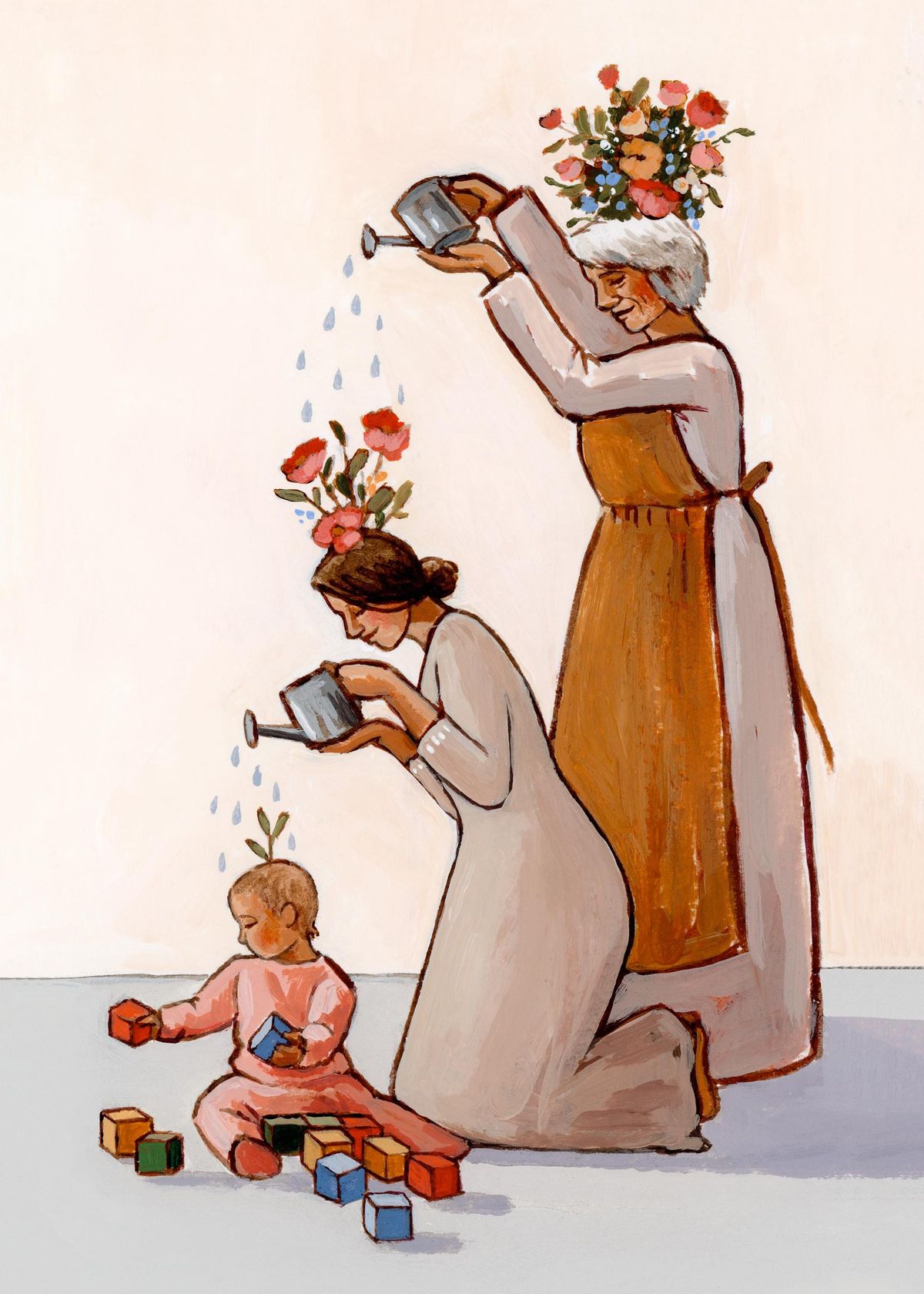

If you've ever caught yourself saying, "I sound exactly like my mom right now," or "I swore I would never parent this way," you are not alone.
Parenting has an intense way of bringing up all the things we thought we had already worked through. I say often to clients, “there’s nothing more triggering than parenthood”.
You can spend years in therapy or reading self-help books, learning about emotional regulation, attachment, and gentle parenting. You can save all the Instagram posts and watch all the Tik-Toks. You can know exactly how you want to respond.
And then your child melts down in the grocery store, refuses to put on shoes for the 47th time, or says something wildly disrespectful after you've already had the hardest day imaginable.
Suddenly, all that parenting knowledge disappears and you find yourself reacting from a place that feels very familiar.
This is one of the biggest things I want parents to understand:
The way you were parented often becomes the way you instinctively parent, especially when you are stressed.
Not because you are destined to repeat the past. Not because you are failing.
But because our brains and nervous systems naturally reach for what they know.
Parenting is not just about learning how to raise your child. It is also about becoming aware of yourself.
The question isn't only: "What kind of parent do I want to be?"
It is also: "What comes naturally to me, and is that actually helping my child thrive?"
Understanding the Four Parenting Styles
Psychologists have studied parenting styles for decades. While no parent fits perfectly into one category all the time, these frameworks can help us understand common patterns and which one we are likely to click into without trying.
Research on parenting styles began with a developmental psychologist Diana Baumrind, who identified three primary styles based on two important factors: parental warmth and parental control. Researchers Eleanor Maccoby and John Martin later expanded this framework to include a fourth style.
(American Psychological Association: Parenting Styles)
Authoritarian Parenting: High Expectations, Low Responsiveness
Authoritarian parenting is often described as a "because I said so" approach.
These parents typically have clear rules and expectations, but there may be less room for discussion, emotional expression, or flexibility.
Structure and obedience are prioritized, but children may have fewer opportunities to practice independence, problem-solving, or emotional communication.
Research has found that authoritarian parenting can be associated with increased anxiety, lower self-esteem, and difficulty with emotional expression compared to more balanced approaches.
(StatPearls: Parenting Styles)
Permissive Parenting: High Warmth, Low Structure
Permissive parents are often deeply loving, accepting, and emotionally available. They may prioritize connection and want their child to feel heard and understood.
The challenge comes when boundaries and expectations are inconsistent or nonexistent. These parents struggle to offer discipline or the word “NO”, often due to their own difficulty seeing their child upset.
Children need warmth, but they also need structure. Limits help children develop emotional regulation, frustration tolerance, and a sense of safety.
A child hearing, "I understand you're upset, and we are still leaving the playground," is experiencing both compassion and guidance. Their feelings are being acknowledged while the boundary remains in place.
In a more permissive parenting approach, the response might sound more like, "I know you really want to stay. I don't want you to be upset. Okay, we can play for five more minutes."
The difference is not that one parent loves their child more. Both parents may be responding from a place of care. The difference is that authoritative parenting recognizes that children need support tolerating disappointment, while permissive parenting may unintentionally prioritize avoiding distress in the moment over building skills for handling frustration.
Uninvolved Parenting: Low Warmth, Low Structure
Uninvolved parenting is characterized by limited emotional responsiveness, guidance, or involvement.
This does not necessarily mean a parent does not love their child. Sometimes this pattern develops because of overwhelming stress, mental health struggles, lack of support, or life circumstances that make consistent parenting difficult.
However, research consistently shows that children need both emotional connection and reliable support in order to thrive.
(American Psychological Association: Parenting Styles)
Authoritative Parenting: High Warmth, High Structure
Authoritative parenting is the style most consistently associated with positive outcomes for children.
And no, authoritative does not mean authoritarian. This distinction matters.
Authoritative parenting combines emotional connection with clear boundaries. These parents listen to their child's feelings while still maintaining expectations.
It sounds like: "I know you are angry that screen time is over. It is okay to feel frustrated. And the answer is still no."
The child's emotions are welcomed. The boundary remains. This balance teaches children something incredibly important: my feelings are allowed, and I can handle limits.
Research has consistently linked authoritative parenting with stronger emotional regulation, independence, social skills, and academic outcomes.
(American Psychological Association: Parenting Styles)
But Here Is What We Don't Talk About Enough
Knowing the "best" parenting style does not automatically make it easy to practice.
This is where so many parents feel shame. They know they want to be calm. They know they want to validate emotions.
They know they don't want to repeat patterns from their own childhood.
But knowing and doing are two different things. Your thinking brain may know exactly how you want to respond. Your nervous system may have learned something different.
Maybe you grew up in a home where emotions were ignored, and now your child's big feelings feel overwhelming.
Maybe you grew up with harsh discipline, and setting boundaries feels uncomfortable because you don't want to hurt your child.
Maybe you experienced unpredictability, and you find yourself trying to control every detail because uncertainty feels unsafe.
Parenting has a way of shining a spotlight on our own healing. Our children do not just learn from what we teach them.
They learn from what we model, what happens when someone (or Mom/Dad) makes a mistake, whether conflict can be repaired in the home and if emotions are something to fear or something we can move through.
The Goal Is Not Perfect Parenting
There is no such thing as a perfect parent. You are going to mess up, scream, and have regrets. One of the biggest misconceptions about parenting is that good parents never lose their patience or make mistakes.
That is not realistic.
Every parent has moments they wish they could redo.
The goal is not perfection. The goal is repair.
Repair might look like: "I yelled earlier, and I wish I had handled that differently. You didn't deserve to be spoken to that way. I was overwhelmed, and I'm working on responding differently."
Those moments matter. They teach children that relationships can survive hard moments. They teach accountability. They teach that love does not disappear when someone makes a mistake.
So What Parenting Style Is Best?
The research is pretty clear: authoritative parenting, the combination of warmth and structure, is consistently associated with the healthiest outcomes for children.
But the goal is not to become a completely different person overnight.
The goal is awareness. It is noticing:
"Am I responding from my values, or am I reacting from my own wounds?"
"Am I setting this boundary because it helps my child feel safe, or because I just want to say NO right now?”
"Am I avoiding conflict because it is best for my child, or because conflict feels uncomfortable for me?"
Those questions are where growth happens. Parenting is not about getting it right every single time.
Something my grandmother used to say all the time was “Small Matters.”
It was her reminder that not every hard moment is a crisis. A spilled drink, a missed opportunity, or a disappointed child can feel big without actually being an emergency.
This idea has helped me so much in my own journey toward consistent authoritative parenting. My child’s feelings matter, but I don't have to fix every feeling or remove every disappointment. Sometimes the most supportive thing I can offer is a calm reminder: “This is hard, and we’re okay.”
It is about creating a relationship where your child knows these things unequivocally:
I am loved.
My feelings matter.
There are boundaries.
Mistakes can be repaired.
I am safe here.
And honestly? That is the kind of parenting most of us are trying to create.